Introduction
Modern enterprises rely on technology to drive innovation, improve customer experiences, and remain competitive in rapidly changing markets. As organizations embrace cloud computing, automation, containerization, and continuous software delivery, the demand for skilled IT and engineering professionals continues to grow. However, adopting modern technologies alone is not enough. Success depends on equipping teams with the knowledge and practical skills needed to use these technologies effectively.
Enterprise DevOps Corporate Training helps organizations build high-performing engineering teams capable of implementing automation, improving collaboration, accelerating software delivery, and maintaining secure, reliable infrastructure. Well-designed corporate training programs provide hands-on experience, practical workflows, and real-world problem-solving techniques that enable employees to contribute more effectively to business transformation initiatives.
Cotocus provides enterprise-focused DevOps corporate training, helping organizations strengthen technical capabilities across DevOps, cloud computing, Kubernetes, DevSecOps, Site Reliability Engineering (SRE), GitOps, platform engineering, infrastructure automation, and CI/CD practices. Businesses interested in enhancing their workforce skills and accelerating digital transformation can explore more at https://www.cotocus.com/.
Why Enterprise DevOps Corporate Training Matters
Digital transformation is changing how organizations develop, deploy, and manage software. Modern IT environments require engineers who understand automation, cloud platforms, container technologies, monitoring, security, and continuous delivery.
Without structured training, organizations often face challenges such as:
- Slow adoption of modern technologies
- Inconsistent development practices
- Manual deployment processes
- Limited collaboration across teams
- Knowledge gaps in cloud-native platforms
- Increased operational risks
- Difficulty scaling engineering operations
- Longer software release cycles
Corporate DevOps training addresses these challenges by creating a shared understanding of modern engineering principles and best practices.
Building High-Performing Engineering Teams
Technology transformation is successful when people, processes, and tools evolve together. Enterprise training helps engineering teams work more efficiently while improving collaboration across departments.
Benefits include:
- Improved technical knowledge
- Standardized engineering practices
- Faster onboarding for new employees
- Increased confidence with modern technologies
- Better communication between development and operations teams
- Reduced deployment errors
- Greater operational consistency
Training empowers teams to adopt new technologies while maintaining business continuity.
Core Areas Covered in Enterprise DevOps Training
A comprehensive DevOps corporate training program addresses the technologies and practices most relevant to enterprise software delivery.
DevOps Fundamentals
Participants learn the principles behind DevOps, including collaboration, automation, continuous improvement, and shared ownership.
Topics include:
- DevOps culture
- Agile collaboration
- Software delivery lifecycle
- Automation strategies
- Continuous improvement
Understanding these concepts provides the foundation for successful DevOps adoption.
Continuous Integration and Continuous Delivery
CI/CD pipelines enable organizations to automate software development, testing, and deployment.
Training covers:
- Source code management
- Build automation
- Automated testing
- Deployment pipelines
- Release strategies
- Pipeline monitoring
Participants gain practical experience designing and maintaining automated delivery workflows.
Cloud Computing and Cloud-Native Practices
Cloud platforms provide flexibility, scalability, and operational efficiency for modern applications.
Corporate training introduces:
- Cloud fundamentals
- Cloud architecture
- Infrastructure provisioning
- Cloud governance
- Cost optimization
- High availability
- Disaster recovery
Understanding cloud-native principles helps teams build scalable and resilient applications.
Kubernetes and Container Technologies
Containers have transformed software deployment by providing consistent runtime environments.
Training programs include:
- Docker fundamentals
- Container architecture
- Kubernetes concepts
- Cluster management
- Workload deployment
- Networking
- Scaling
- Security best practices
Hands-on exercises help participants gain confidence managing containerized applications.
Infrastructure Automation
Manual infrastructure management becomes increasingly difficult as environments expand.
Training introduces Infrastructure as Code (IaC) concepts including:
- Automated provisioning
- Configuration management
- Version-controlled infrastructure
- Environment consistency
- Deployment automation
Infrastructure automation reduces manual effort while improving reliability.
DevSecOps Training
Security should be integrated throughout the software development lifecycle.
Enterprise DevSecOps training covers:
- Secure development practices
- Vulnerability scanning
- Secrets management
- Compliance automation
- Container security
- Secure CI/CD pipelines
- Policy enforcement
Teams learn how to improve application security without slowing software delivery.
Site Reliability Engineering (SRE)
Reliable production environments require proactive operational management.
SRE training includes:
- Monitoring
- Observability
- Incident response
- Service Level Indicators (SLIs)
- Service Level Objectives (SLOs)
- Capacity planning
- Reliability automation
These practices help organizations improve service availability and operational resilience.
GitOps and Modern Deployment Models
GitOps simplifies infrastructure and application management through Git-based workflows.
Training covers:
- Git-based deployments
- Configuration management
- Automated synchronization
- Version control
- Deployment governance
GitOps enables consistent, repeatable, and auditable software delivery.
Platform Engineering
Platform engineering helps organizations create standardized development environments that improve developer productivity.
Training includes:
- Internal developer platforms
- Self-service infrastructure
- Developer experience
- Platform governance
- Reusable engineering services
Well-designed platforms reduce complexity while enabling faster application development.
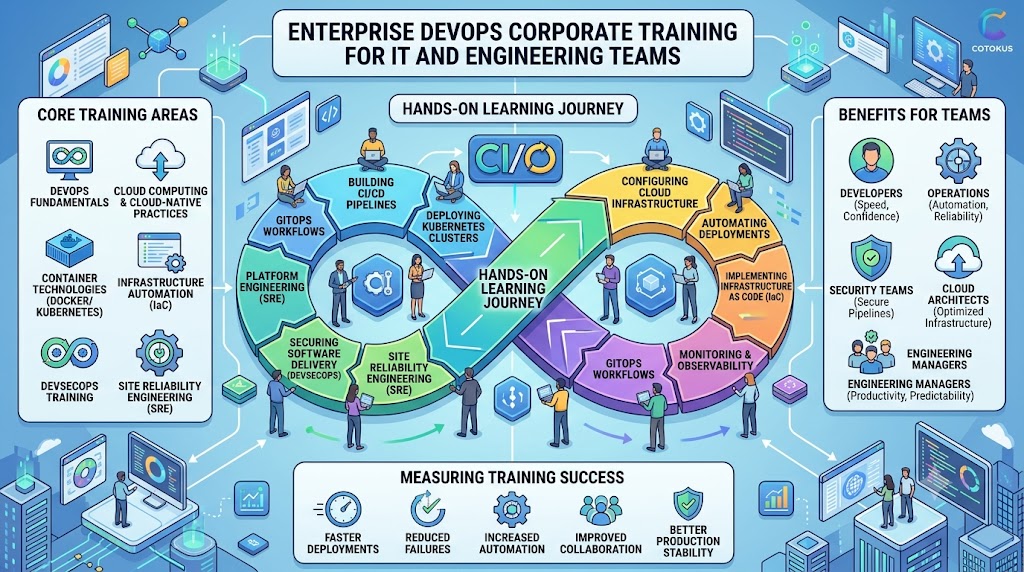
Hands-On Learning for Real Enterprise Environments
Effective corporate training goes beyond theoretical presentations.
Hands-on learning allows participants to:
- Build CI/CD pipelines
- Deploy Kubernetes clusters
- Configure cloud infrastructure
- Automate deployments
- Implement Infrastructure as Code
- Monitor applications
- Secure software delivery pipelines
Practical exercises improve knowledge retention and prepare teams for real production environments.
Benefits for IT and Engineering Teams
Enterprise DevOps corporate training delivers measurable benefits across technical teams.
For Developers
- Faster development workflows
- Better collaboration
- Improved deployment confidence
- Stronger automation skills
For Operations Teams
- Infrastructure automation
- Better monitoring
- Simplified deployments
- Reduced operational complexity
For Cloud Architects
- Modern cloud architecture practices
- Kubernetes expertise
- Infrastructure optimization
- Governance improvements
For Security Teams
- DevSecOps implementation
- Secure pipelines
- Automated compliance
- Improved vulnerability management
For Engineering Managers
- Higher team productivity
- Better release predictability
- Improved collaboration
- Continuous skill development
Measuring Training Success
Organizations should evaluate training effectiveness using measurable outcomes such as:
- Faster deployment frequency
- Reduced deployment failures
- Increased automation adoption
- Improved collaboration
- Better production stability
- Reduced incident response times
- Higher engineering productivity
- Increased employee confidence
These improvements contribute directly to business performance and digital transformation goals.
Enterprise DevOps Training vs Traditional Technical Training
| Traditional Technical Training | Enterprise DevOps Corporate Training |
|---|---|
| Tool-focused learning | End-to-end engineering practices |
| Theory-heavy sessions | Practical hands-on labs |
| Individual learning | Cross-functional collaboration |
| Limited automation | Automation-first approach |
| Separate technology domains | Integrated cloud-native ecosystem |
| Static infrastructure | Infrastructure as Code |
| Manual deployments | CI/CD automation |
| Security after development | Integrated DevSecOps |
| Limited operational focus | Reliability and observability included |
Why Organizations Choose Cotocus
Successful enterprise training requires experienced instructors, practical content, and an understanding of real-world engineering challenges.
Cotocus delivers corporate training programs designed to help organizations strengthen technical capabilities across DevOps, cloud computing, Kubernetes, DevSecOps, Site Reliability Engineering, GitOps, infrastructure automation, CI/CD, and platform engineering. The focus remains on practical implementation, knowledge transfer, and enabling teams to apply modern engineering practices within enterprise environments.
By combining consulting expertise with enterprise training, Cotocus helps organizations build internal capabilities that support long-term technology modernization and business growth.
Frequently Asked Questions
What is Enterprise DevOps Corporate Training?
Enterprise DevOps Corporate Training is a structured learning program that helps IT and engineering teams develop practical skills in automation, cloud technologies, CI/CD, Kubernetes, DevSecOps, and modern software delivery.
Who should attend DevOps corporate training?
Developers, system administrators, DevOps engineers, cloud architects, SRE teams, security professionals, platform engineers, QA engineers, engineering managers, and IT leaders all benefit from enterprise DevOps training.
Why is hands-on training important?
Hands-on exercises help participants apply theoretical concepts to real-world scenarios, improving confidence, retention, and practical problem-solving skills.
What technologies are typically included?
Training often covers Git, Docker, Kubernetes, CI/CD pipelines, Infrastructure as Code, cloud platforms, monitoring, DevSecOps, GitOps, and automation tools.
How does DevOps training improve business outcomes?
Well-trained teams deliver software faster, reduce deployment risks, improve collaboration, strengthen security, and increase operational efficiency.
Does DevOps training support cloud adoption?
Yes. Enterprise training prepares teams to design, deploy, and manage cloud-native applications while following best practices for scalability, governance, and automation.
What is the role of DevSecOps in training?
DevSecOps training teaches teams how to integrate security throughout the software development lifecycle, reducing vulnerabilities and improving compliance.
Why is Kubernetes included in DevOps training?
Kubernetes has become the industry standard for container orchestration, making it an essential skill for managing modern cloud-native applications.
How long should corporate DevOps training last?
The duration depends on organizational goals, team experience, and training objectives. Programs may range from short workshops to comprehensive multi-week learning paths.
Why choose Cotocus for enterprise training?
Cotocus combines practical industry knowledge, enterprise consulting experience, hands-on learning, and modern technology expertise to help organizations develop highly skilled IT and engineering teams capable of supporting long-term digital transformation.
Conclusion
Enterprise DevOps Corporate Training is a strategic investment for organizations seeking to improve software delivery, strengthen engineering capabilities, and support cloud-native digital transformation. By building expertise in automation, Kubernetes, DevSecOps, Site Reliability Engineering, infrastructure automation, CI/CD, and platform engineering, businesses can create agile teams prepared to meet evolving technology demands.
Cotocus helps enterprises develop these capabilities through practical corporate training programs designed for real-world implementation. Whether your organization is beginning its DevOps journey or expanding existing engineering expertise, visiting https://www.cotocus.com/ is an excellent starting point to explore professional training and consulting services that support sustainable business growth.
