Introduction
Modern software development is driven by speed, automation, scalability, and continuous improvement. Organizations are rapidly adopting cloud-native technologies, Infrastructure as Code (IaC), container orchestration, and automated delivery pipelines to stay competitive. As these technologies evolve, working engineers need structured learning that goes beyond tool-specific knowledge and focuses on building practical, production-ready skills.
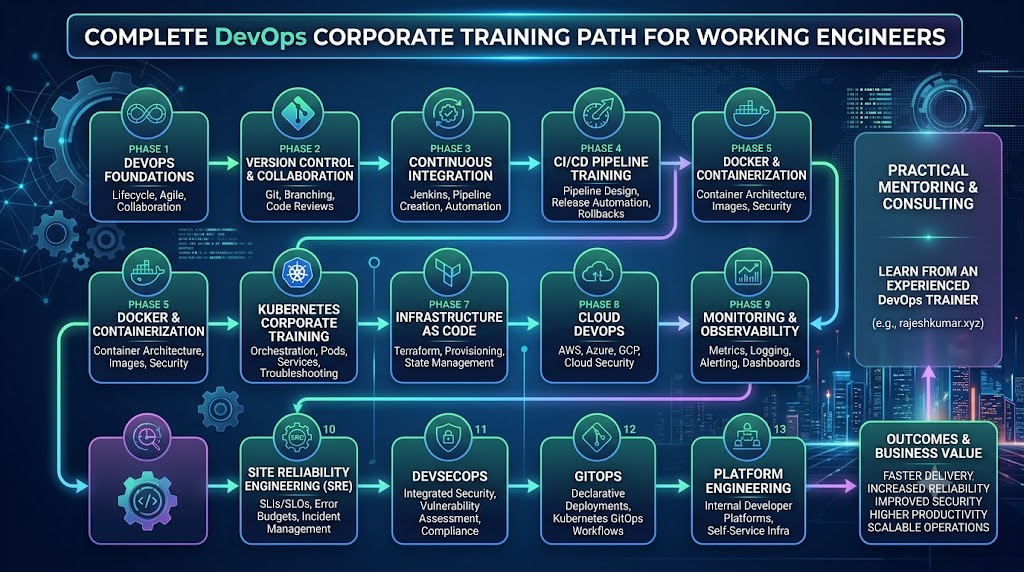
A well-designed DevOps Corporate Training program enables engineers to understand the complete software delivery lifecycle—from source code management to production monitoring. Instead of learning individual technologies in isolation, engineers develop an integrated understanding of automation, cloud infrastructure, CI/CD, Kubernetes, Site Reliability Engineering (SRE), DevSecOps, and Platform Engineering.
Professionals and organizations looking for practical enterprise training and mentoring can explore https://www.rajeshkumar.xyz/ to learn more about Rajesh Kumar’s experience in DevOps consulting, corporate training, cloud technologies, and modern engineering practices.
Why Working Engineers Need Structured DevOps Corporate Training
Many engineers learn DevOps tools independently through online tutorials or documentation. While this approach builds foundational knowledge, enterprise environments require engineers to understand how different technologies work together within complex production systems.
Structured DevOps Corporate Training helps engineers:
- Learn complete software delivery workflows
- Understand enterprise DevOps practices
- Build cloud-native deployment skills
- Improve collaboration across development and operations teams
- Reduce manual operational work
- Develop production troubleshooting capabilities
- Gain confidence with automation tools
- Apply best practices consistently across projects
An experienced DevOps Trainer focuses on practical implementation, helping engineers solve real-world business challenges rather than simply learning commands.
Phase 1: DevOps Foundations
Every successful DevOps journey begins with a strong understanding of DevOps principles and culture.
Key learning areas include:
- DevOps lifecycle
- Agile development
- Collaboration between development and operations
- Continuous improvement
- Automation principles
- Version control concepts
- Software delivery workflows
Understanding these fundamentals helps engineers appreciate why automation and collaboration are essential for modern software delivery.
Phase 2: Version Control and Collaboration
Source code management forms the backbone of DevOps workflows.
Training covers:
- Git fundamentals
- Branching strategies
- Merge requests
- Code reviews
- Repository management
- Collaborative development
- Release workflows
Engineers learn how efficient version control supports faster development and reliable deployments.
Phase 3: Continuous Integration with Jenkins
Automation begins with Continuous Integration (CI), where code changes are automatically validated through builds and testing.
Jenkins Training typically includes:
- Jenkins architecture
- Pipeline creation
- Build automation
- Automated testing
- Artifact management
- Pipeline optimization
- Integration with source control
- Deployment workflows
These skills help organizations detect issues early and maintain high software quality.
Phase 4: CI/CD Pipeline Training
After Continuous Integration comes Continuous Delivery and Continuous Deployment.
A practical CI/CD Pipeline Training program teaches engineers how to automate the complete application delivery process.
Topics include:
- Pipeline design
- Deployment strategies
- Automated testing
- Approval workflows
- Rollback mechanisms
- Release automation
- Environment management
- Production deployment
Automated pipelines improve deployment consistency while reducing manual effort.
Phase 5: Docker and Containerization
Containers have become the standard deployment model for modern applications.
Comprehensive Docker Kubernetes Training begins with Docker fundamentals:
- Container architecture
- Docker images
- Containers
- Docker networking
- Volumes
- Docker Compose
- Image optimization
- Container security
Understanding containers prepares engineers for Kubernetes-based production environments.
Phase 6: Kubernetes Corporate Training
Kubernetes is the industry’s leading platform for container orchestration.
An experienced Kubernetes Trainer helps engineers understand:
- Kubernetes architecture
- Pods
- Deployments
- ReplicaSets
- Services
- ConfigMaps
- Secrets
- StatefulSets
- Ingress
- Storage
- Networking
- Autoscaling
- Troubleshooting
Organizations also benefit from Kubernetes Corporate Training, ensuring engineering teams follow standardized deployment practices across projects.
Phase 7: Infrastructure as Code
Modern infrastructure is managed through code rather than manual configuration.
Terraform Training introduces engineers to:
- Infrastructure provisioning
- Modules
- Variables
- State management
- Remote backends
- Cloud resource automation
- Infrastructure lifecycle management
Infrastructure as Code enables repeatable, reliable, and scalable cloud environments.
Phase 8: Cloud DevOps
Cloud platforms are central to enterprise DevOps strategies.
A structured learning path includes:
- AWS fundamentals
- Azure basics
- Google Cloud Platform overview
- Networking
- Identity and Access Management
- Storage services
- Compute services
- Cloud security
- Cost optimization
An experienced Cloud DevOps Consultant and AWS DevOps Consultant can help organizations apply these technologies effectively in production environments.
Phase 9: Monitoring and Observability
Deploying applications is only part of the DevOps lifecycle. Engineers must also monitor application health and system performance.
Training typically covers:
- Metrics collection
- Logging
- Distributed tracing
- Dashboards
- Alerting
- Incident response
- Capacity planning
- Performance monitoring
Observability enables engineering teams to identify and resolve production issues quickly.
Phase 10: Site Reliability Engineering
As organizations scale, reliability becomes a key engineering priority.
A practical SRE Trainer introduces engineers to:
- Service Level Indicators (SLIs)
- Service Level Objectives (SLOs)
- Error budgets
- Incident management
- Production readiness
- Reliability automation
- Capacity management
- Post-incident reviews
Comprehensive Site Reliability Engineering Training helps organizations build highly available and resilient systems.
An experienced SRE Consultant also guides enterprises in adopting reliability engineering practices across teams.
Phase 11: DevSecOps
Security must be integrated throughout the software delivery lifecycle rather than added during the final stages.
A knowledgeable DevSecOps Trainer covers:
- Secure coding practices
- Static code analysis
- Dependency scanning
- Container security
- Secret management
- Compliance automation
- Vulnerability assessment
- Policy enforcement
- Security monitoring
DevSecOps Corporate Training helps organizations build secure software delivery pipelines without slowing development.
Phase 12: GitOps
GitOps extends Infrastructure as Code by making Git the single source of truth for deployments.
A practical GitOps Training program includes:
- GitOps principles
- Declarative deployments
- Continuous reconciliation
- Deployment automation
- Rollback strategies
- Kubernetes GitOps workflows
- Configuration management
GitOps simplifies deployment management while improving consistency across environments.
Phase 13: Platform Engineering
As engineering organizations mature, Platform Engineering improves developer productivity by providing standardized internal platforms.
A Platform Engineering Consultant helps organizations design:
- Internal developer platforms
- Self-service infrastructure
- Standard deployment templates
- Shared engineering services
- Governance frameworks
- Automation platforms
Platform Engineering Training prepares engineers to build and operate scalable internal platforms that simplify software delivery.
Technologies Covered During Corporate Training
| Area | Tools / Topics | Business Value |
|---|---|---|
| Source Control | Git | Collaborative development |
| CI | Jenkins Training | Automated builds |
| CD | CI/CD Pipeline Training | Faster software releases |
| Containers | Docker Kubernetes Training | Cloud-native deployment |
| Container Orchestration | Kubernetes Corporate Training | Scalable applications |
| Infrastructure | Terraform Training | Automated infrastructure |
| Cloud | AWS DevOps | Reliable cloud operations |
| Monitoring | Prometheus, Grafana, ELK | Improved observability |
| Security | DevSecOps | Secure software delivery |
| Reliability | SRE | High system availability |
| Automation | GitOps Training | Consistent deployments |
| Developer Platforms | Platform Engineering | Increased productivity |
Why Learn from an Experienced DevOps Trainer
An experienced DevOps Trainer offers much more than classroom instruction. Practical mentoring helps engineers understand how technologies interact within enterprise environments.
Benefits include:
- Real-world implementation guidance
- Production-focused learning
- Hands-on laboratories
- Best practices
- Troubleshooting techniques
- Enterprise architecture discussions
- Cloud migration insights
- Practical automation strategies
Working with an experienced mentor helps engineers gain confidence in applying DevOps concepts to real business scenarios.
Best Fit Audience
This training path is ideal for:
- DevOps Engineers
- Cloud Engineers
- Software Developers
- Platform Engineers
- SRE Professionals
- DevSecOps Engineers
- System Administrators
- Build and Release Engineers
- Engineering Managers
- Corporate L&D Teams
- Startup Engineering Teams
- Enterprise Technology Leaders
Business Benefits of DevOps Corporate Training
Organizations investing in structured training gain long-term operational and business advantages.
Key benefits include:
- Faster software delivery
- Better engineering collaboration
- Reduced manual operations
- Increased deployment reliability
- Improved cloud adoption
- Stronger security practices
- Better production monitoring
- Higher developer productivity
- Reduced downtime
- Consistent engineering standards
- Improved customer experience
- Scalable cloud-native operations
Frequently Asked Questions
1. Why should companies invest in DevOps Corporate Training?
DevOps Corporate Training helps engineering teams adopt standardized automation, CI/CD, cloud technologies, Kubernetes, and Infrastructure as Code while improving collaboration and software delivery.
2. What does a DevOps Trainer teach?
A DevOps Trainer covers DevOps fundamentals, Git, Jenkins, CI/CD, Docker, Kubernetes, Terraform, cloud platforms, monitoring, DevSecOps, GitOps, and Platform Engineering using practical examples.
3. Who should attend Kubernetes Corporate Training?
Software developers, DevOps engineers, cloud engineers, platform engineers, operations professionals, and architects responsible for containerized applications and Kubernetes environments.
4. How does Site Reliability Engineering Training improve operations?
Site Reliability Engineering Training teaches observability, automation, incident management, monitoring, and reliability engineering practices that help reduce downtime and improve production performance.
5. Why is Platform Engineering Training important for enterprises?
Platform Engineering Training helps organizations build standardized internal developer platforms that improve productivity, reduce operational complexity, and enable consistent software delivery.
Conclusion
Modern enterprises require engineers who understand automation, cloud-native technologies, security, reliability, and scalable software delivery. A structured DevOps Corporate Training path equips working professionals with the technical knowledge and practical experience needed to build, deploy, secure, and operate modern applications efficiently.
Whether organizations need guidance from a DevOps Trainer, DevOps Consultant, Kubernetes Trainer, SRE Trainer, DevSecOps Trainer, Platform Engineering Consultant, Cloud DevOps Consultant, or AWS DevOps Consultant, investing in comprehensive training creates stronger engineering teams capable of supporting long-term business growth and digital transformation.
To learn more about Rajesh Kumar’s corporate training, consulting, and technical mentoring services, visit https://www.rajeshkumar.xyz/ and discover how practical DevOps expertise can accelerate your organization’s engineering excellence.
