Introduction
Kerala’s past lives in old streets, painted halls, coastal forts, and places of worship. Each place tells a different story about the people who shaped the state.
Some sites show how traders crossed the sea. Others reveal royal life, local craft, faith, and struggles for power.
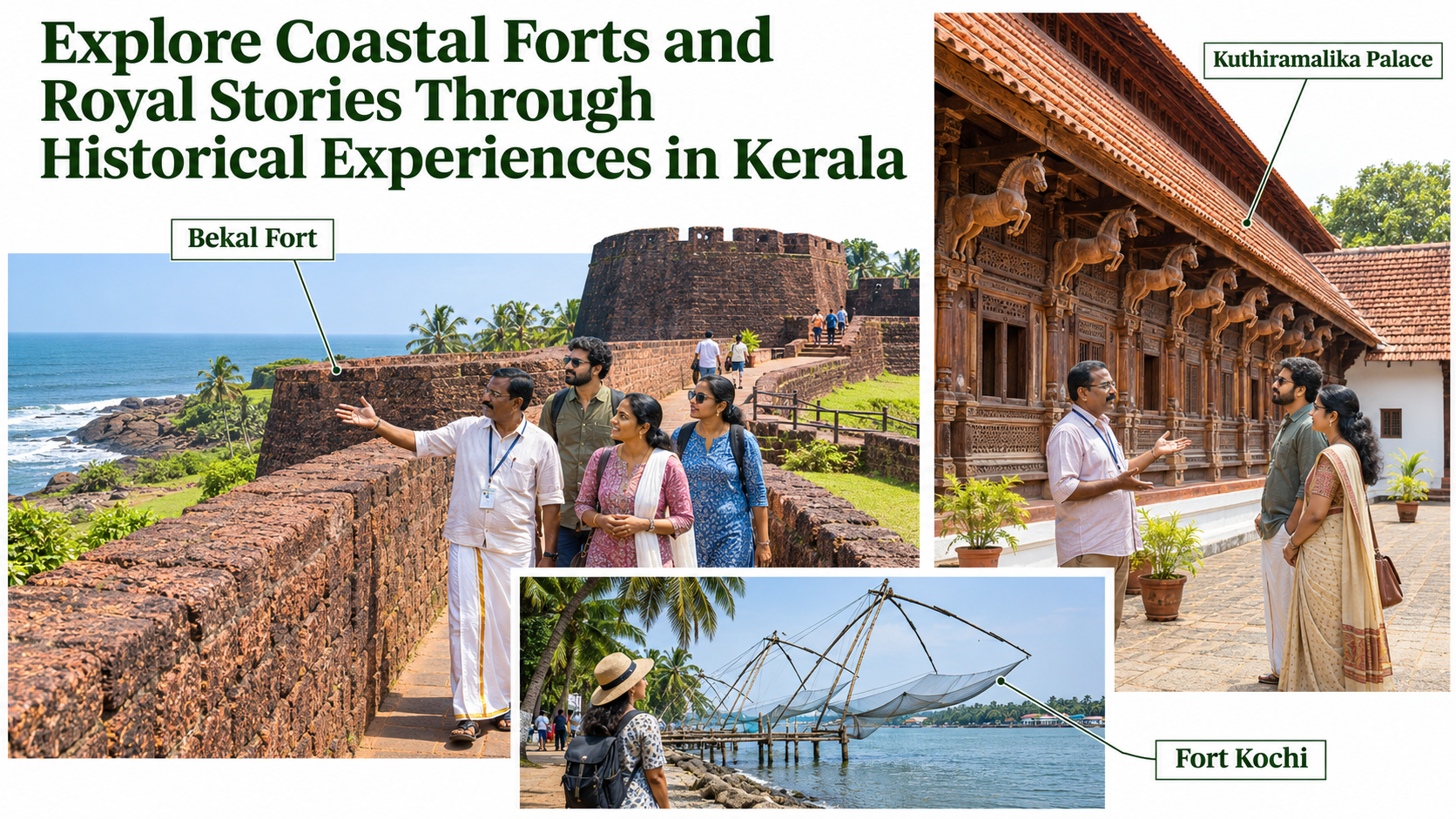
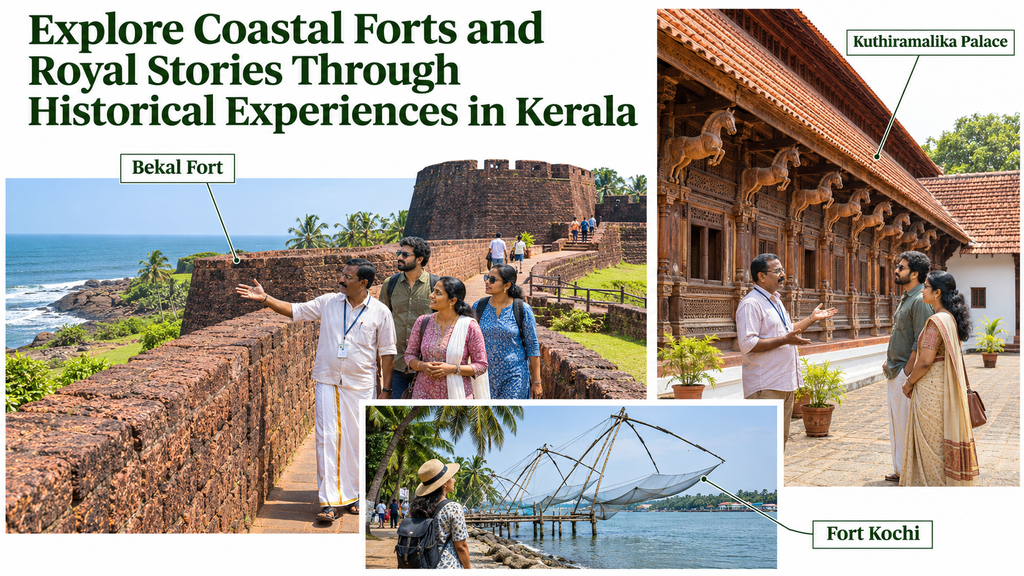
The best historical experiences in Kerala include Fort Kochi, Mattancherry, the Muziris area, Bekal Fort, and Kuthiramalika Palace. However, these places sit in different parts of Kerala.
So, start with one region and explore it well. A calm visit gives you more time to understand what you see.
This article explains the main places and the steps for planning your trip. You will also find route ideas, budget checks, and advice for families.
Kerala Orbit can help you explore local events alongside your history plans. Then, confirm each site’s entry rules before travelling.
1. Explore Fort Kochi Through a Heritage Walk
Fort Kochi offers a good starting point for a first history trip. Its streets bring together churches, old buildings, waterfront life, and traces of sea trade.
Begin with a short walk near St Francis Church. Then, explore nearby lanes before heading towards the Chinese fishing nets.
Look at roof shapes, doors, windows, and street names. These small details help you notice changes that a quick drive would miss.
Next, ask a guide about the people behind the buildings. Local workers, traders, and families matter as much as foreign rulers.
Plan your visit in this order:
- Choose a clear meeting point.
- Confirm the walk’s length and language.
- Check which buildings allow entry.
- Walk at a comfortable pace.
- Stop for water and rest.
Also, respect people who live and work along the route. Keep doorways clear and ask before taking close photos.
Finally, remember that Fort Kochi is a neighbourhood. Do not expect one large fort with a single entrance.
2. Study Royal Art and Jewish Heritage in Mattancherry
Mattancherry combines several stories within one area. You can explore royal art, Jewish heritage, and streets linked with trade.
Start at Mattancherry Palace, which people also call the Dutch Palace. The Portuguese built it, and the Dutch later repaired it.
The rulers of Kochi used the palace. So, its familiar name explains only part of its past.
Inside, look closely at the murals, which are paintings on walls. Choose one scene and ask about its story.
Next, study the royal objects and rooms around the central courtyard. Notice how the building’s layout differs from a modern home.
Then, explore nearby Jew Town and the Paradesi Synagogue when visitor access allows. A synagogue is a Jewish place of worship.
Check entry times and photo rules separately for each place. Also, ask about stairs before visiting with anyone who needs easier access.
Finally, browse shops with care. A seller’s story does not prove that an object is old or rare.
3. Follow Ancient Trade Stories Through the Muziris Area
The Muziris heritage area spreads across several places north of Kochi. It offers a wider look at trade, communities, and life near waterways.
Possible stops include Paliam heritage buildings, Paravur Synagogue, Kottappuram Fort, and Pattanam. You do not need to visit them all.
First, choose a theme. You might prefer old homes, community history, or objects found beneath the ground.
Next, select a small group of sites. Confirm transport between them rather than assuming you can walk everywhere.
Pattanam offers a chance to learn about ancient trade through objects and remains. Finds include pottery linked with distant regions.
However, researchers still debate its exact link with ancient Muziris. Treat that link as a research question rather than a settled fact.
Also, avoid expecting a complete ancient town above ground. Ask which displays and visitor areas currently welcome guests.
Finally, check the exact stops before booking any package. The name “Muziris tour” alone does not explain the full route.
4. Explore Coastal Defence at Bekal Fort
Bekal Fort stands beside the Arabian Sea in Kasaragod. Its walls and coastal views help explain why this location mattered.
Start by studying the site layout. Then, follow marked visitor paths through the open areas.
Look at the thick walls and places where guards could watch the shore. Ask how the fort’s design helped defend the coast.
Next, notice the building material and the land around it. A fort’s setting often explains as much as its walls.
Prepare for the visit carefully:
- Wear shoes with a good grip.
- Carry water and sun cover.
- Keep children close near edges.
- Follow barriers and staff directions.
- Take extra care after rain.
Do not climb walls or enter closed areas for photos. Also, leave enough time to walk back comfortably.
Plan Bekal within a north Kerala trip. Adding it to a short Kochi visit can create too much travel.
Finally, use the sea view to understand the history, rather than treating it only as a photo background.
5. Discover Royal Craft at Kuthiramalika Palace
Kuthiramalika Palace stands in Thiruvananthapuram. People also know it as Puthenmalika Palace.
The palace offers a closer look at royal objects and Kerala’s building craft. Its carved wooden horses give it a memorable name.
First, check opening hours and the available visitor route. Ask whether the visit includes guided explanations.
Next, find out about stairs, seating, bags, footwear, and photography. These details help you plan a smoother visit.
Inside, look beyond the main objects. Study ceilings, pillars, roof shapes, and small wooden details.
Ask how these features served daily life. A palace needed useful spaces as well as fine decoration.
Then, choose one object and learn its purpose. This can reveal more than rushing through every room.
The palace stands near Padmanabhaswamy Temple. However, the temple has separate entry rules.
Do not assume that palace admission includes temple entry. Confirm each visit on its own before adding both to your day.
Real Experience & Personal Stories
Small details often become the strongest travel memories. You may remember a painted face, a letter, or a carved roof more clearly than a whole building.
During your visit, keep a short travel note. Write one thing you noticed and one fact you learned.
Next, add a question that still interests you. This gives you something to explore after the trip.
You can also speak with guides and local people. However, ask politely and respect anyone who prefers not to talk.
Seek permission before recording a story or sharing someone’s photo. Also, keep facts separate from your feelings.
This article does not claim a personal visit. These steps help you create your own honest travel story.
Case Studies & Success Stories
The following sample plans show how clear goals can improve a trip. They describe possible visits, rather than real customer results.
A family visiting Kochi chooses a short Fort Kochi walk. After lunch, they explore one indoor heritage site.
Their goal is to help each child remember one story. They avoid filling the day with too many stops.
An art lover chooses Mattancherry Palace. They spend longer studying a few murals and asking about their meaning.
A visitor staying near Kasaragod chooses Bekal Fort. They explore local history without adding a long journey south.
Each plan fits the traveller’s needs. Success means learning comfortably, rather than collecting the most place names.
Original Insights & Opinions
Kerala’s history becomes clearer when you connect places through one theme. Trade offers a useful starting point.
At Fort Kochi, notice the waterfront and streets. In the Muziris area, study objects that reveal links across the sea.
However, do not tell the whole story through foreign visitors. Local communities shaped trade, faith, craft, and daily life too.
My recommendation is to choose one main question for each outing. For example, ask how the sea influenced the place.
Also, compare what different sources tell you. A museum label, guide, and local story may offer different views.
A thoughtful visit makes room for those differences without treating every claim as equally certain.
Industry Statistics & Research Data
Reliable numbers should help explain a place. They should not serve as decoration or proof that one site is “best.”
Kerala Tourism records 122 carved wooden horses at Kuthiramalika Palace. This gives visitors a clear feature to notice.
However, the number alone cannot explain the skill behind the work. Look at the shapes, repeated details, and place within the building.
Research also includes uncertainty. At Pattanam, objects support a story of early trade and wider sea links.
Its exact connection with ancient Muziris remains a matter of debate. So, ask what the finds prove and what researchers still question.
Avoid using unsourced visitor counts or popularity claims when choosing your trip.
Step-by-Step Guides & Tutorials
Follow these steps to build a practical heritage trip.
Step 1: Choose your main interest.
Pick sea trade, royal life, wall paintings, faith, or forts. This helps you choose places with a shared story.
Step 2: Choose one region first.
Start with Kochi, the Muziris area, north Kerala, or Thiruvananthapuram. Do not treat the whole state as one day-trip area.
Step 3: Select one main stop per half-day.
Use this as a planning starting point. Add nearby places only when travel time and your group’s energy allow.
Step 4: Check current access.
Confirm opening hours, weekly closures, entry rules, and any repair work. Also, check whether all rooms welcome visitors.
Step 5: Ask about walking needs.
Find out about steps, uneven paths, seating, and toilets. Share any access needs before booking a tour.
Step 6: Arrange your full journey.
Plan how you will arrive and return. If you use a ferry, check the current route and return service.
Step 7: Confirm transport charges.
Ask about waiting time, parking, tolls, and extra stops. Get the full amount rather than only a starting fare.
Step 8: Choose a guide when useful.
Agree on the language, route, length, and price. A good guide should welcome questions and explain uncertain points clearly.
Step 9: Set a complete budget.
Count transport, entry, guides, meals, and accommodation if needed. Keep some spare money for changes.
Step 10: Pack for the conditions.
Bring water, rain cover, sun cover, and suitable shoes. Save booking details and important contacts on your phone.
Step 11: Recheck before leaving.
Review weather and local travel updates. Confirm your meeting point and any last-minute changes with the host.
Step 12: Review what you learned.
After the visit, write three useful facts. Then, explain one story in your own words.
Expert Interviews & Quotes
A useful guide should explain the evidence behind a story. Ask whether a claim comes from records, objects, or local tradition.
Kerala Tourism describes Kuthiramalika as the “Mansion of Horses.” The name points visitors towards its carved horse features.
Use that detail to ask a deeper question. Find out how the carvings fit into the wider building.
At Mattancherry Palace, ask about the meaning of one mural. At Pattanam, ask what a pottery piece can reveal about trade.
This article includes no private expert interview. Still, these questions can help you learn more from a real guide.
Clear answers matter more than a fast speech full of unfamiliar names.
Detailed Comparisons: Guided Visits vs Exploring Alone
Both approaches can work well. Your choice depends on your interests, budget, and comfort with reading displays.
| Approach | Main benefit | Main limit | Useful for |
|---|---|---|---|
| Guided visit | Explains stories and small details | Adds cost and a shared pace | First visits and complex sites |
| Exploring alone | Gives freedom to pause | Requires more preparation | Quiet viewing and focused interests |
| Guided start, then free time | Combines context with personal choice | Needs agreement on the plan | Families and mixed-interest groups |
Choose a guide when the remains seem hard to understand. Explore alone when clear displays meet your needs.
Also, ask what the guide fee includes. Transport and site entry may cost extra.
No guide can promise access to a closed area. Confirm the route before paying.
Unique Frameworks & Methodologies
Try a simple method called Place, People, Proof, Present. It helps you connect old objects with real life.
Place: Notice the setting. Ask why people chose this spot for a port, palace, or fort.
People: Learn who lived, worked, traded, or worshipped there. Look beyond the names of rulers.
Proof: Find an object or feature that supports the story. It might be pottery, a letter, or a wall painting.
Present: Link the idea with life today. Compare an old trade route with the way goods reach your town.
Then, share one clear thought with your group. Children can draw a feature instead of writing about it.
Real Examples & Use Cases
Use these sample outlines to choose a suitable starting point. Adjust them to your location, interests, and current access.
| Your situation | Suggested focus | Main planning need |
|---|---|---|
| First visit to Kochi | Fort Kochi and Mattancherry | Site hours and travel between stops |
| Interest in ancient trade | Selected Muziris sites | Exact route and transport |
| Staying in north Kerala | Bekal Fort | Weather and walking comfort |
| Visiting Thiruvananthapuram | Kuthiramalika Palace | Entry hours and access |
| Travelling with children | One short walk and one focused site | Breaks and simple learning tasks |
Kerala Orbit can help you explore events around your chosen region. A suitable event may add another view of local culture.
However, confirm each offer separately. Check the host, venue, duration, and included services.
Do not assume that an event ticket includes monument entry or transport.
Budget, Weather, and Comfort Checks
A low ticket price does not always mean a low-cost outing. Travel, guides, meals, and waiting charges can form a larger share.
So, compare the full day’s cost before booking. Also, ask about refund terms if weather changes your plans.
For outdoor walks and forts, avoid filling the hottest part of the day with long stretches on foot. Allow regular breaks.
During heavy rain, review travel conditions and site access. Wet steps and uneven paths may need extra care.
For older relatives, confirm seating and walking distance early. For children, carry water and keep the route simple.
These small checks protect the time and money you spend on the visit.
Common Mistakes to Avoid
The biggest mistake is planning too many distant places. Long journeys can leave little time for the history itself.
Another mistake is assuming that nearby sites share opening hours. A palace, museum, and place of worship may follow different schedules.
Also, avoid treating every guide’s story as a proven fact. Ask politely about the source when something sounds uncertain.
Do not touch murals, lean on old objects, or cross barriers for photos. Follow staff directions throughout the visit.
Finally, spend some time looking without your phone. A few careful photos can support your memory.
They should not replace the experience of noticing the place directly.
Frequently Asked Questions About Kerala Orbit
1. What is Kerala Orbit?
Kerala Orbit lists events and shares travel content about Kerala. You can use it to explore ideas for your visit.
2. Can Kerala Orbit help me plan a history trip?
It can help you discover content and available events. Confirm monument entry, travel, and site access separately.
3. Does Kerala Orbit offer every heritage tour in Kerala?
Do not assume that it does. Check current listings and read the exact route before booking.
4. Does an event ticket include monument entry?
It depends on the offer. Ask whether entry, transport, meals, and guide services form part of the price.
5. Which historical experience suits a first visit?
Fort Kochi and Mattancherry offer varied stories within the Kochi area. Choose a manageable route rather than rushing through everything.
6. Can I visit all the listed places in one day?
No. Bekal, Kochi, and Thiruvananthapuram lie far apart. Plan separate regional visits or a longer trip with travel days.
7. Are historical visits suitable for children?
Yes. Keep walks short and focus on simple stories. Ask children to choose one object and explain its purpose.
8. Can older visitors enjoy these places comfortably?
Comfort depends on the site and route. Ask about stairs, seating, toilets, and walking distance before making plans.
9. Should I hire a guide for the Muziris area?
A guide can help connect separate sites and explain the finds. First, confirm the stops, language, duration, and fee.
10. Where should I check current entry rules?
Contact the site office, official tourism service, or confirmed tour host. Recheck the details shortly before travelling.
Final Thought
Choose a trip that gives you time to understand each place. Kerala’s history rewards close attention more than a crowded checklist.
Start with one region and one clear interest. Then, build a route that suits your budget, time, and walking comfort.
Use Kerala Orbit to explore events that may fit around your visit. Confirm the details before paying or travelling.
Most of all, stay curious about ordinary things. A carved roof, painted wall, or broken pottery piece can open a much larger story.
