Introduction
Modern IT environments generate enormous amounts of operational data from applications, servers, cloud platforms, containers, networks, and monitoring systems. As organizations continue to adopt cloud-native technologies and distributed architectures, traditional IT operations teams often struggle to manage growing complexity.
This is where AIOps comes into play.
AIOps, or Artificial Intelligence for IT Operations, combines machine learning, big data analytics, automation, and observability to help organizations detect anomalies, correlate events, identify root causes, predict incidents, and automate operational tasks.
Whether you are a DevOps Engineer, Site Reliability Engineer, Cloud Engineer, System Administrator, IT Manager, or a student exploring emerging technologies, learning AIOps can significantly improve your career opportunities and technical expertise.
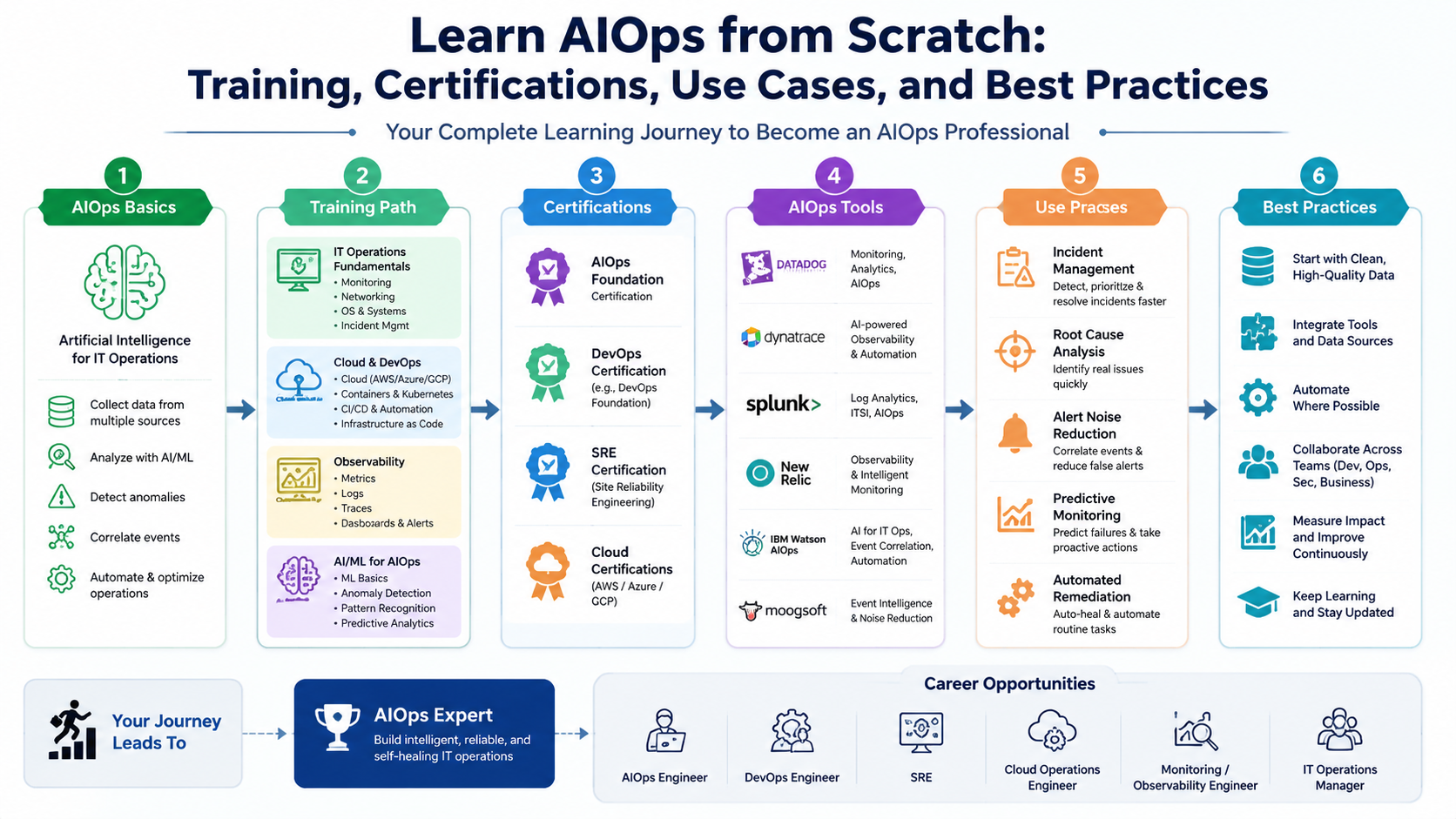
In this guide, you’ll learn AIOps from scratch, including its fundamentals, training paths, certifications, use cases, tools, and best practices.
What is AIOps?
AIOps stands for Artificial Intelligence for IT Operations. The term refers to the use of artificial intelligence and machine learning technologies to enhance and automate IT operations processes.
AIOps platforms collect and analyze large volumes of data from:
- Monitoring tools
- Log management systems
- Cloud environments
- Applications
- Network devices
- Infrastructure components
- Service management platforms
By analyzing this data in real time, AIOps solutions help organizations:
- Detect anomalies automatically
- Reduce alert noise
- Correlate related events
- Identify root causes faster
- Predict future incidents
- Automate remediation actions
The ultimate goal is to improve operational efficiency, reliability, and service availability.
Why AIOps Matters Today
Organizations are rapidly adopting:
- Cloud computing
- Kubernetes
- Microservices
- DevOps practices
- Multi-cloud environments
- Hybrid infrastructure
These technologies generate millions of events and logs daily.
Manual monitoring approaches are no longer sufficient because:
- Alert volumes continue to grow
- Root cause analysis becomes more complex
- Incident resolution takes longer
- Operational costs increase
AIOps addresses these challenges by introducing intelligence and automation into IT operations workflows.
Core Components of AIOps
Data Collection
AIOps platforms collect data from multiple sources, including:
- Metrics
- Logs
- Traces
- Events
- Alerts
- Tickets
Big Data Analytics
Collected data is normalized and processed to identify patterns and relationships.
Machine Learning
Machine learning algorithms analyze historical and real-time data to:
- Detect anomalies
- Identify trends
- Predict failures
Event Correlation
Multiple alerts are grouped together to reduce noise and identify actual incidents.
Root Cause Analysis
AIOps helps teams quickly determine the source of a problem.
Automation
Routine operational tasks can be automated to reduce manual effort.
Benefits of Learning AIOps
High Industry Demand
Organizations across industries are investing in intelligent IT operations.
Better Career Opportunities
AIOps skills complement roles such as:
- DevOps Engineer
- SRE
- Cloud Engineer
- Platform Engineer
- IT Operations Engineer
- Monitoring Specialist
Improved Problem-Solving Skills
Understanding AIOps improves your ability to manage modern infrastructure.
Future-Proof Expertise
AI-driven operations are becoming a standard requirement for enterprise IT teams.
Higher Operational Efficiency
AIOps professionals help organizations reduce downtime and improve service quality.
Skills Required to Learn AIOps
You do not need to be a data scientist to start learning AIOps.
A strong foundation in the following areas is helpful:
IT Operations
Understanding:
- Servers
- Networks
- Operating systems
- Monitoring
Cloud Computing
Knowledge of:
- AWS
- Azure
- Google Cloud
DevOps
Understanding:
- CI/CD
- Automation
- Infrastructure as Code
Monitoring and Observability
Experience with:
- Metrics
- Logs
- Traces
- Dashboards
Basic Machine Learning Concepts
Understanding:
- Pattern recognition
- Anomaly detection
- Predictive analytics
AIOps Learning Roadmap
Step 1: Learn IT Operations Fundamentals
Start with:
- Linux administration
- Networking basics
- Monitoring concepts
- Incident management
Step 2: Learn Cloud Technologies
Understand:
- Cloud infrastructure
- Containers
- Kubernetes
- Distributed systems
Step 3: Study Observability
Focus on:
- Metrics
- Logs
- Traces
- Application monitoring
Step 4: Learn Automation
Explore:
- Scripting
- CI/CD
- Infrastructure automation
Step 5: Understand AI and Machine Learning Basics
Learn:
- Supervised learning
- Unsupervised learning
- Anomaly detection models
Step 6: Explore AIOps Platforms
Gain hands-on experience with leading AIOps tools.
AIOps Certifications Worth Considering
Certifications provide structured learning and industry recognition.
AIOps Foundation Certification
Ideal for beginners.
Covers:
- AIOps concepts
- AI fundamentals
- Machine learning basics
- Operational use cases
DevOps and SRE Certifications
Helpful complementary certifications include:
- DevOps Foundation
- SRE Foundation
- Cloud Certifications
Observability Certifications
Useful for professionals working with monitoring and analytics platforms.
Popular AIOps Tools
Several tools support AIOps initiatives.
Splunk IT Service Intelligence
Offers:
- Event correlation
- Predictive analytics
- Service monitoring
Dynatrace
Provides:
- AI-powered observability
- Root cause analysis
- Performance monitoring
Datadog
Supports:
- Infrastructure monitoring
- Application monitoring
- AI-assisted troubleshooting
New Relic
Provides intelligent observability and incident analysis.
IBM Watson AIOps
Uses AI for:
- Incident management
- Event correlation
- Automated remediation
Moogsoft
Specializes in:
- Noise reduction
- Event intelligence
- Incident detection
Real-World AIOps Use Cases
Incident Management
AIOps helps identify and resolve incidents faster.
Root Cause Analysis
AI algorithms identify the underlying causes of system failures.
Alert Noise Reduction
Thousands of alerts can be consolidated into a single actionable incident.
Capacity Planning
AIOps predicts future resource requirements.
Predictive Maintenance
Potential failures are detected before service disruptions occur.
Cloud Operations
AIOps improves visibility across complex cloud environments.
Security Monitoring
AI assists in identifying unusual activity and operational risks.
AIOps for Site Reliability Engineering
Site Reliability Engineering teams benefit significantly from AIOps.
Key advantages include:
- Faster incident response
- Reduced Mean Time to Resolution
- Improved service reliability
- Automated remediation
- Better observability
AIOps enables SRE teams to focus on reliability improvements rather than repetitive operational tasks.
AIOps for DevOps Teams
DevOps teams use AIOps to improve:
Continuous Monitoring
Real-time insights throughout the delivery pipeline.
Deployment Analysis
Detection of deployment-related issues.
Automated Incident Response
Faster remediation of production problems.
Service Reliability
Improved availability and user experience.
Common Challenges in AIOps Adoption
Data Quality Issues
Poor-quality data reduces AI effectiveness.
Tool Integration Complexity
Multiple systems must be integrated successfully.
Skills Gap
Organizations need professionals who understand both operations and AI.
Change Management
Teams must adapt to new operational workflows.
Initial Investment
Successful implementation requires planning and commitment.
Best Practices for Learning and Implementing AIOps
Start with Fundamentals
Build strong IT operations knowledge first.
Learn Observability
Understanding monitoring and telemetry is essential.
Gain Hands-On Experience
Practice with real tools and environments.
Focus on Use Cases
Understand how AIOps solves business problems.
Learn Automation
Automation is a core pillar of successful AIOps strategies.
Understand Business Impact
Connect technical improvements to business outcomes.
Pursue Certifications
Structured certification programs accelerate learning.
Continue Learning
AIOps technologies evolve rapidly and require ongoing skill development.
Career Opportunities in AIOps
Growing demand exists for professionals in roles such as:
- AIOps Engineer
- DevOps Engineer
- Site Reliability Engineer
- Cloud Operations Engineer
- Platform Engineer
- IT Operations Analyst
- Monitoring Engineer
- Observability Engineer
Organizations increasingly seek professionals capable of combining operations expertise with AI-driven automation skills.
Future of AIOps
The future of AIOps is closely tied to:
- Generative AI
- Autonomous operations
- Intelligent automation
- Advanced observability
- Predictive analytics
- Self-healing infrastructure
As IT environments continue to grow in complexity, AIOps will become a critical component of modern operations strategies.
Conclusion
AIOps represents the next evolution of IT operations, helping organizations manage complex digital environments through artificial intelligence, machine learning, automation, and observability. By reducing alert fatigue, accelerating root cause analysis, improving incident response, and enabling predictive operations, AIOps delivers significant value to both technical teams and businesses.
For professionals looking to build future-ready careers, now is an excellent time to learn AIOps. Start by mastering IT operations fundamentals, cloud technologies, observability, and automation. Follow a structured training path, pursue relevant certifications, gain hands-on experience with industry-leading tools, and apply best practices to real-world scenarios. As enterprises continue adopting AI-driven operations, AIOps skills will remain highly valuable across DevOps, SRE, cloud, and IT operations roles.
